In some ways, Western Washington University’s (WWU) CREST program more closely resembles a summer camp or even what one teacher jokingly referred to as a ‘teaching spa’ than a typical professional development session.
“The whole second week is about treating teachers as experts, and we like to say we’re the fairy godmothers that week,” says D. Debi Hanuscin, Professor of Elementary Education, Science, Math & Technology at WWU. “We get their materials, make their copies and serve them so that they can do the important work of teaching, not all the grunt and prep work.”
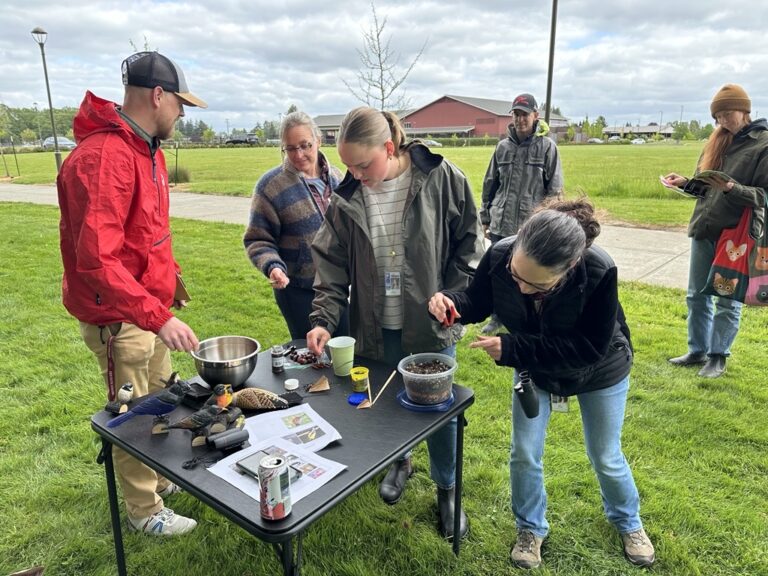
But make no mistake, deep professional development is occurring – it just may look a bit different than what most teachers are used to. CREST stands for Culturally Responsive Elementary Science Teaching, a two-year research project through WWU. During two weeks on the university’s campus, elementary educators became familiar with Explore the Salish Sea (ESS), a place-based science curriculum with a strong Indigenous focus, before putting it into practice the following week with students. ESS is available on PEI’s website and PEI’s team has been facilitating cohort sessions using the ESS curriculum for the past two years.

It’s a rare opportunity to immediately use what they’re learning in a practical format while being supported both by other teachers within their cohort and professors like Hanuscin and Dr. Josie Melton, STEM Education Research Associate.
Some teachers worked with their own students, while others visited WWU’s recreation camp or Community Boating Center camps. “They have a week in the learner seat and then the next week, the teachers collaborate so they can learn from each other and support one another in their implementation,” Hanuscin notes. “That’s something you normally don’t get to do.”
Along the way, they’re encouraged to modify and provide feedback on the units. “The teachers seem almost surprised that we wanted them to adapt the curricula,” says Hanuscin. “For many years, our field has approached curriculum implementation from a fidelity perspective, saying, ‘This is a script for you to follow.’ Giving teachers autonomy and honoring and valuing the expertise, recognizing that adaptation is necessary and not a bad thing, was really powerful.”
Two cohorts met simultaneously during the workshop. One began the program last fall and has been implementing and modifying it over the last school year. The other is new to the material and will repeat the same process in the coming year.
“Over and over, the students said, ‘Every kid in the district should get to do this unit.’How often do you hear kids say, ‘We get to do science’ or ‘We get to learn about this?’”
— Dr. Debi Hanuscin, Western Washington University
During the practicum week, the benefits of this approach to learning become clear. Elementary students from Northern Heights School in Bellingham completed an ESS unit that included building a Remotely Operated Vehicle (ROV) to explore the ocean floor as part of a focus on endangered Southern Resident Orcas. They shared their experience during a summit on campus.
“Over and over, they said, ‘Every kid in the district should get to do this unit,’” explains Hanuscin. “How often do you hear kids say, ‘We get to do science’ or ‘We get to learn about this?’”
Another teacher found that the curriculum’s braiding of Western science and Indigenous Ways of Knowing had an unexpected impact. “He has students from the Nooksack Tribe in his class, and a student actually brought in some dentalium shells in a necklace that was really sacred to her family,” explains Melton. “How indigenous people collected dentalium is part of a story in the unit. He shared how special it was to be able to connect with that student in a way he hadn’t been able to throughout the rest of the year.”
Several other teachers were concerned that a young student on the spectrum might not be able to participate but instead found that she thrived. “She was so engaged, taking a leadership role and working with other kids,” says Hanuscin. “It was really wonderful for the education staff who worked with her during the year to see what was possible for her.”
Over the next year, researchers will continue to collect data as teachers implement culturally responsive learning in their classrooms. An additional cohort will complete the same training in the spring.
“We’ve heard the word ‘transformative’ over and over,” Hanuscin maintains. “It definitely focuses teachers on practicing their craft, improving instructional practice, as opposed to following instructions.”