Megan Klinich has attended multiple professional development workshops where participants debated the merits of teaching about forestry. As an Advanced Placement Environmental Science teacher in the process of creating a forestry course from scratch, she found those discussions counterproductive; she already knew the relevance of this critical industry for students in Kitsap County, a region surrounded by forests on Washington State’s Olympic Peninsula. What she lacked was concrete information about how to teach the topic in a way that engaged students while providing training aligned to genuine employer needs.
Then she attended Engaging Communities in Forestry Education (ECFE), a two-day in-person workshop where teachers learned forest management practices, climate science, and strategies for
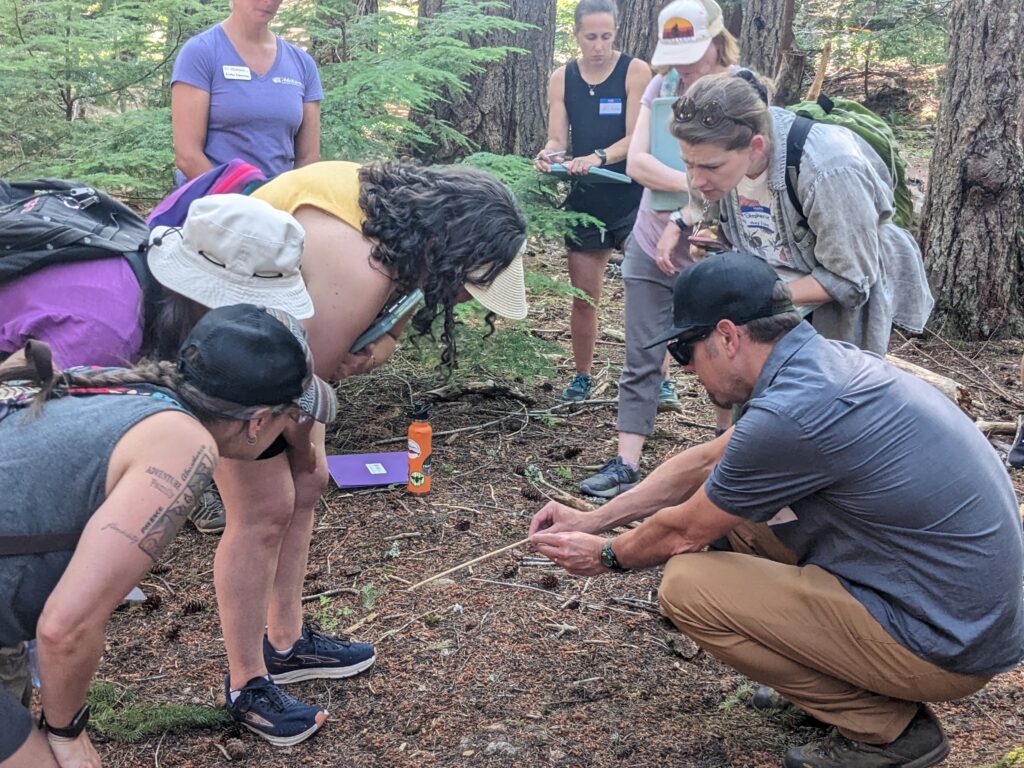
applied learning with students.
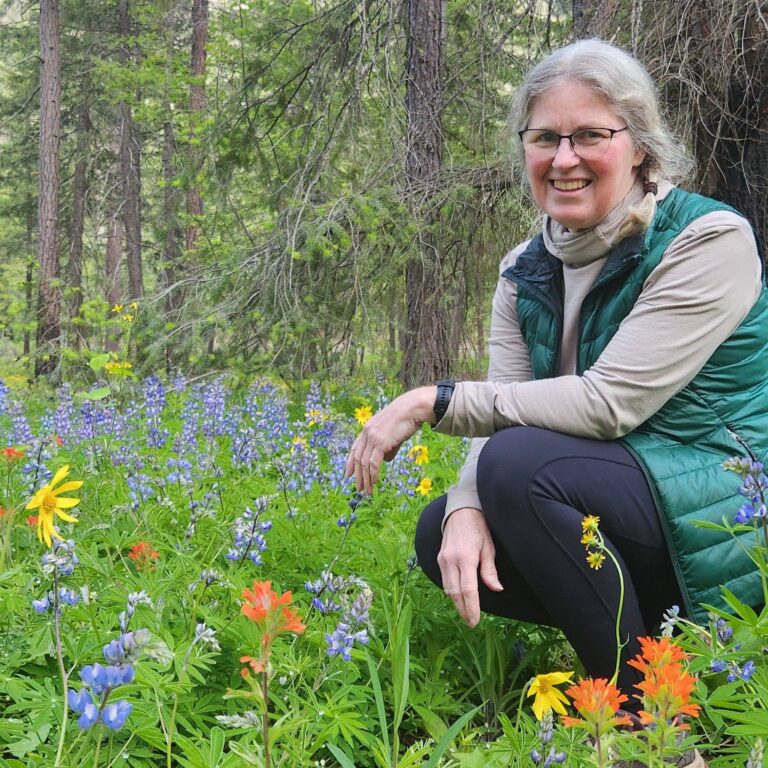
“It was different because I was meeting with industry professionals,” says Klinich. “The entire workshop was about how forestry works and how we can connect that to the community, versus why forestry education matters. They already know it matters. It was refreshing.”
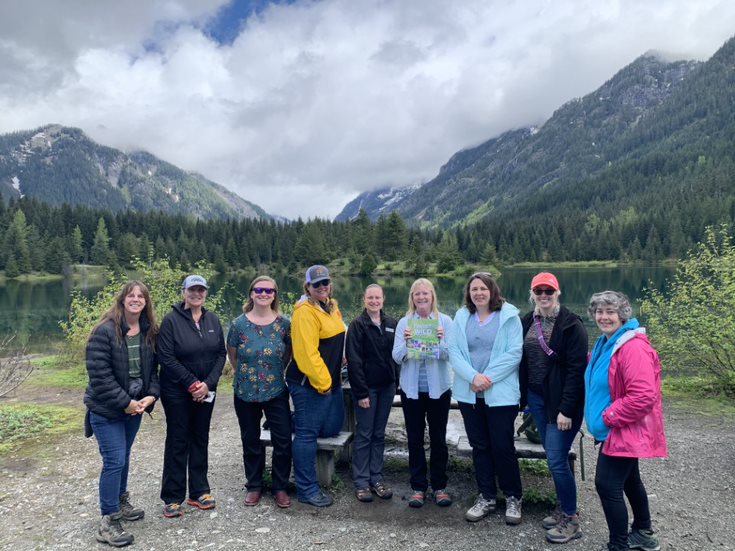
The ECFE workshop model cultivates connections between K-12 and industry in order to enhance student learning by providing context and meaning to daily classroom experiences. The concept was born of a collaboration between PEI, Sierra Pacific Industries, a timber company, and Skagit Conservation District. The goal was to create a format that would allow educators to understand the many social and ecological benefits and trade-offs that occur in forests and farms and the different land management objectives at play; to meet people who work in those sectors and build personal relationships with them; and to consider how they could apply their new knowledge in the classroom. ECFE workshops are designed with ample time for reflection, planning, and collaboration among educators and presenters.
“[This workshop] was different because I was meeting with industry professionals. The entire workshop was about how forestry works and how we can connect that to the community, versus why forestry education matters. They already know it matters. It was refreshing.”
— AP Environmental Science Teacher Megan Klinich
“We wanted to address misconceptions teachers have about the natural resource sector,” says Kathryn Kurtz, PEI’s Executive Director. “It was important for them to see how current technology and mechanization are used to mediate known negative impacts and understand why some practices are necessary, even if they have impacts on the environment. We also wanted them to think about how they would approach teaching content differently, reflecting on what they learned and what questions they still have, and how to pursue those answers.”
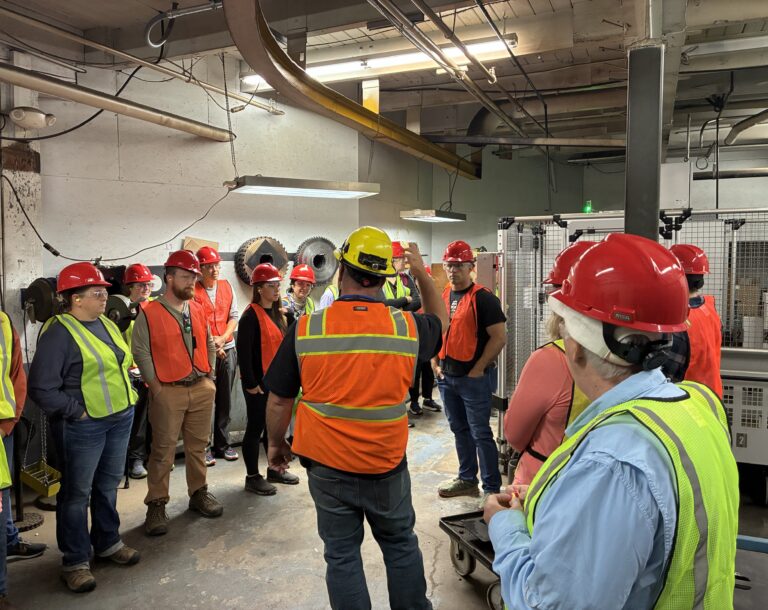
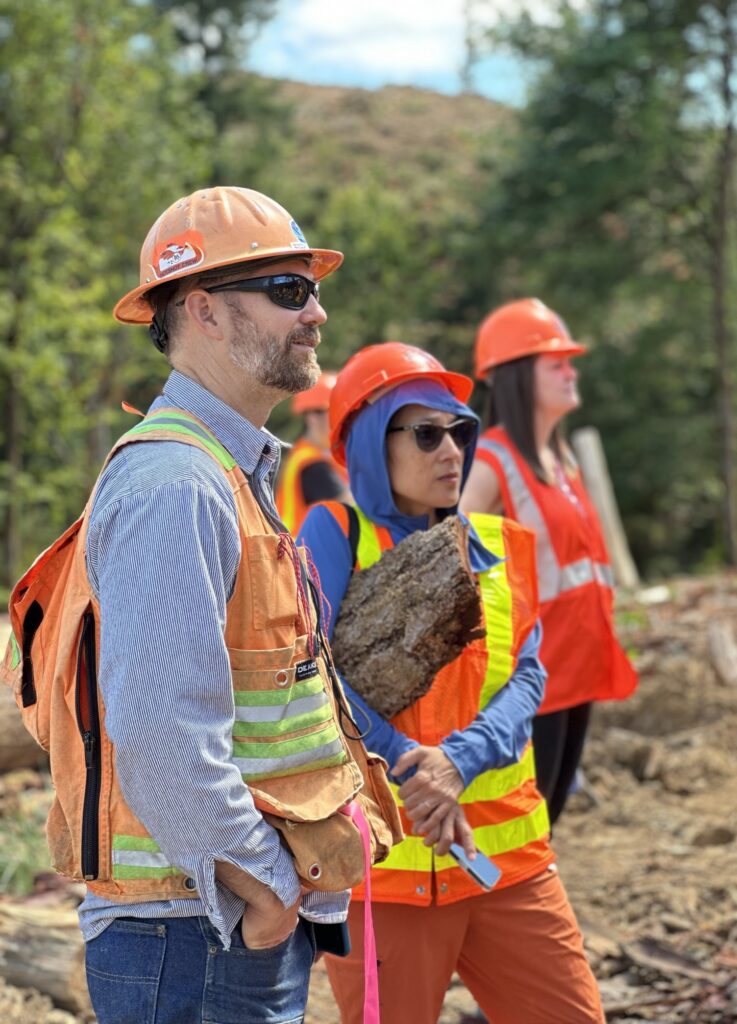
ECFEs are intentionally designed to be experiential. During the ‘ECFE: Forests, Fire and Community’ workshop Klinich attended, teachers toured a newly harvested and planted site on one of Hampton Lumber’s working forests, conducted a forest plot study, learned about forest health indicators and how scientists manage for fire, and explored Project Learning Tree (PLT) resources. PLT is an international organization providing activities and resources to engaged children in learning about the environment through the lens of trees and forests.

They heard from forest management professionals representing the Washington Department of Natural Resources, Hampton Lumber, and the Upper Skagit Tribe Natural Resource Department. Often, ECFEs will include tours of mills and working forests. They’ll also feature panels of professionals sharing differing perspectives on forest management while emphasizing the critical role of inter-agency collaboration.
That’s a message students appreciate, according to Klinich. “They’re incredibly interested. They’ve only seen the negative side of forestry, so seeing that there are ways to manage forest land safely and understanding that it can be both sustainable and profitable has led to invaluable discussions. Their final project for my forestry course is to make land management plans for ten acres. Some are making plans for their family properties, and their parents are excited to see what they come up with.”
For companies like Hampton Lumber, ECFEs support education and outreach efforts. “We want to increase awareness and exposure for students and teachers so they can have a comprehensive understanding of how modern forest management is done,” says Jessica Espy, Hampton’s North Cascades Outreach Coordinator. “This workshop is perfect for achieving those goals because it allowed us to first understand the need that teachers have regarding curriculum, and then it provided an effective framework to engage students. Working with PEI helped bridge gaps in understanding and fostered such a wonderful opportunity for learning in the field.”
Espy hopes that participants come away with a new understanding of the regulations governing the timber industry and the connection professional foresters have with the environment. “It’s starkly different from the way people think,” she notes. “The industry today operates under extensive environmental protections. We want people to walk away realizing that those who work in the woods care deeply about the environment. Foresters have considerable training and education in things like silviculture and forest engineering and they’re out in the woods every day. I think teachers appreciate the opportunity to talk with our foresters and benefit from their knowledge and experience.”
“Imbuing teachers with these practices and information allows them to pass that on to the next generation of farmers and agriculture professionals. Programs like these, especially when they occur year after year, bind our community together. We work with our neighboring conservation district in Stevens County and with the Kalispel Natural Resources Department. That increases awareness and strengthens trust while opening the door for more students to participate in outdoor learning and natural resource education.”
— Stephen Allen, Pend Oreille Conservation District Communications Manager
Members of Washington’s Upper Skagit Tribe also care deeply about forests. They’ve been practicing sustainable forestry for over 10,000 years, says Upper Skagit Tribe Natural Resources & Cultural Policy Representative Scott Schuyler. Schuyler shares that history with educators during ECFEs. “It’s enlightening for people to understand that we’ve been practicing sustainable forest management for 5,000 years before King Tut,” Schuyler explains. “Our ancestors on Baker Lake would strip cedar trees for clothing and nets, and those trees are still alive today, two or three hundred years later. Our practices haven’t changed much; we just use different tools.”
ECFEs provide an opportunity to pass on tribal values, he says. “We’re constantly struggling to reinforce these ideas of the value of environmental protection with the general public. We teach our kids to leave things better than you found them, and that’s something we strive to do every day, by the restoration work that we do, the education work that we do, and advocating for environmental protection because of the future.”
Klinich appreciates that perspective, noting that her community is home to two sovereign nations in the Suquamish Tribe and the Port Gamble S’Klallam Tribe. “To have this blend of the biology of forestry, the economic side from the industry that I’ve learned at the training, and then the cultural side has been this beautiful blend where we’re seeing all these different pieces together,” she says. “It’s been very beneficial for my community as a whole.”
Much of the research around STEM professional development for educators focuses on technology in other sectors such as computer engineering and aerospace. However, one systemic literature
review of immersive STEM Learning Placements in Industry (Butler, Hurley, Mcloughlin, 2023) noted that “it’s possible to maximize teachers’ professional learning through a program that is structured to provide opportunities to enhance teacher content knowledge, to provide experience of scientific inquiry and to provide effective instruction in best practices such as inquiry – and problem-based learning.”
Other research explores key factors for quality teacher training programs. In their research brief Effective Teacher Professional Development, Learning Policy Institute analysts identified seven key elements of professional development that led to better student outcomes, including professional development that:
- supports collaboration, typically in job-embedded contexts
- provides coaching and expert support
- offers opportunities for feedback and reflection (Darling-Hammond, Gardner, and Hyler, 2019).
Washington’s Climate Commitment Act (CCA) funding supported the first several years of ECFEs. The CCA supports Washington’s climate action efforts by putting cap-and-invest dollars to work reducing climate pollution, creating jobs, and improving public health. Information about the CCA is available at www.climate.wa.gov. Skagit County and Whatcom Conservation Districts, Rayonier, Weyerhaeuser Giving Fund, Hampton Lumber, Sierra Pacific Industries Community Fund, Sustainable Forestry Initiative (SFI), Washington State Implementation Committee (WASIC), and Washington Tree Farm Program Bob Faulkner Education Fund have also provided funding for specific workshops.
In the last two years, PEI has expanded beyond ECFEs to offer Engaging Communities in Agriculture Education (ECAE) and Engaging Communities in Climate Education (ECCE) workshops. Ashley Karsh teaches all subjects to a combined 7th and 8th-grade class at a small, rural middle school in Spokane’s Summit Valley School District. She recently attended a one-day in-person ECAE workshop focused on soil health and regenerative agriculture practices.
“This was so relevant and applicable to my students,” says Karsh. “I couldn’t believe the number of resources and collaboration involved in this workshop. We had PEI, two different county conservation districts, the Natural Resources Conservation Service, and WSU Vetter Demonstration Farm and Forest. My focus is on bringing these connections into the classroom.”
At the workshop, educators learned about soil health through experiments and demonstrations and embarked on an ecosystem hunt to discover how biotic and abiotic components and processes define the way we depend on ecosystems for food. They also joined Stevens and Pend Oreille Conservation Districts to learn how to take samples and collect field data to understand the importance of soil in agriculture.
The topic made it easy to integrate curriculum, says Karsh. “This year in my English Language Arts (ELA) unit, we were reading novels that dealt with people in the Dust Bowl and Great Depression era,” she explains. “These lessons on soil health blend into ELA, social studies, and science. What caused the Dust Bowl? Why did it impact so many people? It was really cool to have the depth of topics available through this workshop to help build our learning.”
Stephen Allen is the Communications Manager for Pend Oreille Conservation District. Allen designed the NRCS Equity in Outreach program that funds ECAEs in Eastern Washington as part of the organization’s mission of advancing stewardship and responsible resource management. He also works closely with PEI staff to facilitate the program and conduct outreach to educators. “Imbuing teachers with these practices and information allows them to pass that on to the next generation of farmers and agriculture professionals,” he says. “Programs like these, especially when they occur year after year, bind our community together. We work with our neighboring conservation district in Stevens County and with the Kalispel Natural Resources Department. That increases awareness and strengthens trust while opening the door for more students to participate in outdoor learning and natural resource education.”
Often, educators are surprised by the amount of community resources and support available to them, Allen notes. Many aren’t aware of how much regenerative agriculture is happening in their neighborhoods and how that could be integrated into the curriculum. “We expose them to local farms and projects such as the WSU Extension Vetter Farm and Forest, and they have the opportunity to share those with their students.” POCD also conducts ECFE workshops in collaboration with PEI, DNR and the Kalispel Tribe’s Natural Resources Department.
Across the state in Kitsap County, Klinich’s forestry course now includes a partnership with Great Peninsula Conservancy, a regional community land trust. The Conservancy recently acquired one hundred acres of poorly managed deforested land that has been taken over by invasive scotch broom.
“It’s been great to work with community partners,” says Klinich. “My kids are going to make forest management plans for these hundred acres, and we’ll implement them on this new land. The students will help clear the scotch broom, replant a forest, and see what that’s like. Many of them say, ‘I didn’t know this was an option for me.’”
PEI plans to continue offering these collaborative workshops and expanding the menu to include natural resource industries like aquaculture & fisheries, a critical industry in Washington State.
References
Gardner, Kimberly, Glassmeyer, David, Worthy, Roneisha (2019) “Impacts of STEM Professional Development on Teachers’ Knowledge, Self-Efficacy, and Practice.” Frontiers in Education https://www.frontiersin.org/journals/education/articles/10.3389/feduc.2019.00026/full
Darling-Hammond, Linda, Hyler, Maria E., Gardner, Madelyn, with assistance from Danny Espinoza (2017) “Effective Teacher Professional Development.” Learning Policy Institute https://learningpolicyinstitute.org/sites/default/files/product-files/Effective_Teacher_Professional_Development_BRIEF.pdf