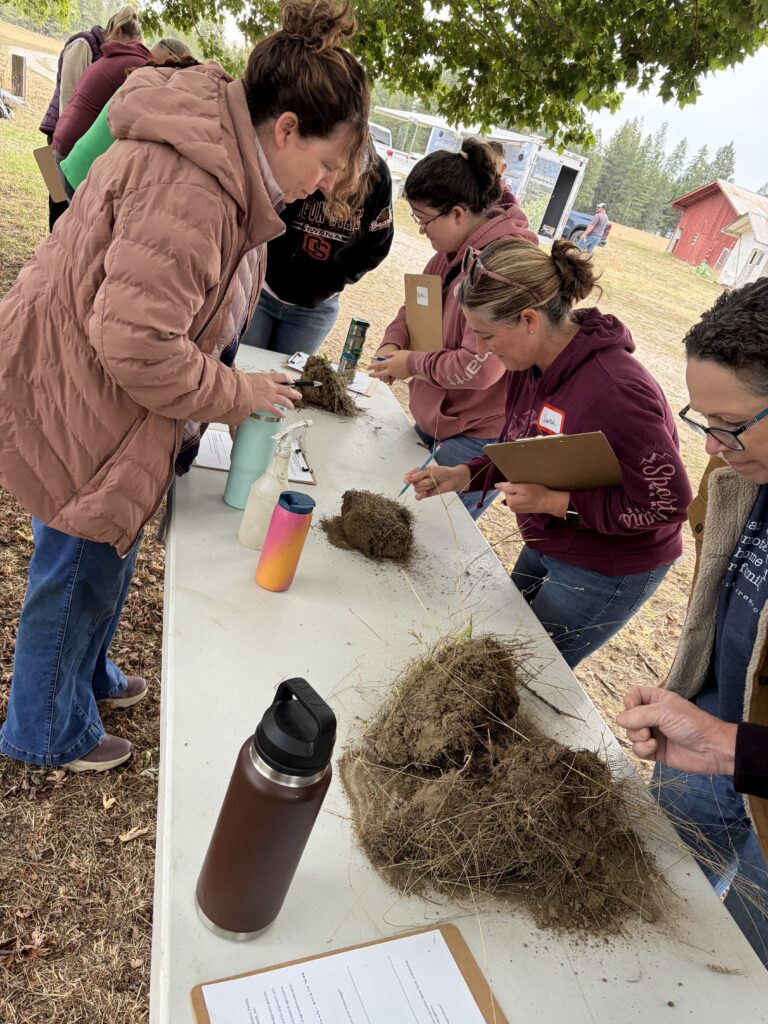
It’s hard to imagine a more attention-getting activity for students of all ages than the Soil Your Undies Challenge. The name alone evokes questions, and the process is a memorable way for students to understand the multiple factors impacting soil health, as 21 K-12 educators learned at an Engaging Communities in Agriculture Education workshop in September.
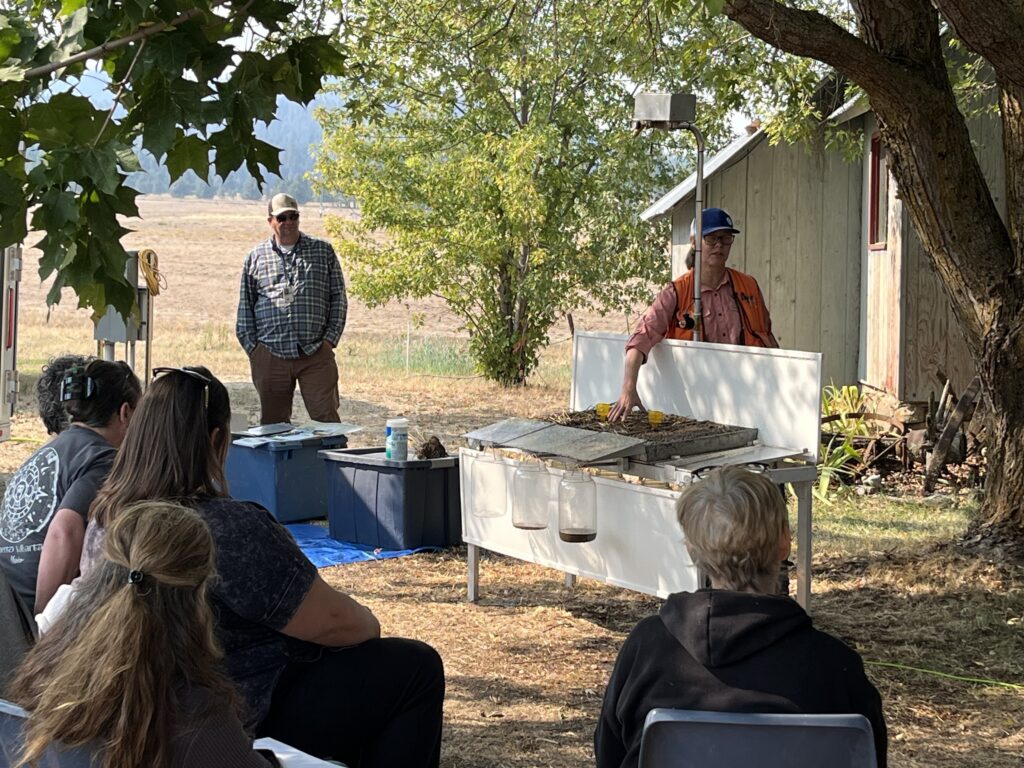
A team from Natural Resources Conservation Service (NRCS) demonstrated the activity, which involves burying new, cotton-based underwear at different sites with varying ecosystem soil conditions. When the underwear is dug up after 60 days, increased microbial activity, an indicator of healthy soil, can be observed. Underwear buried in healthy soil had hardly a shred of material left other than the synthetic elastic waistband.
“This was a fantastic opportunity to see different ways to incorporate agriculture education into different classroom settings,” one educator shared. “[The workshop] provided great networking and resource opportunities.”
The one-day, in-person workshop provided training and resources for educators to integrate agriculture education and career-connected learning into their practice, connect with local community partners and learn about opportunities for students to participate in field-based agricultural learning experiences.
“This was a fantastic opportunity to see different ways to incorporate agriculture education into different classroom settings. “[The workshop] provided great networking and resource opportunities.”
— Workshop Participant
Teachers from twelve school districts were represented between Ferry, Stevens, Pend Oreille, and Spokane Counties. The spread across the grade levels was evenly distributed. Pacific Education Institute’s (PEI) Amy Dawley and Michelle Townshend teamed up with staff from Pend Oreille Conservation District, Stevens Conservation District, and NRCS to co-facilitate the workshop. The workshop was funded by a NRCS grant.
Other highlights included another NRCS demonstration, this time of how no-till, low-till and tilled soil interact with water through a slake test. “The Soil Health Trailer was a big hit,” says Dawley. “It provided a clear visual observation of how intact microbial and fungal soil components, plus living plant roots, create stable soil that does not easily break apart and erode within water. They also demonstrated wind erosion across the surface of a miniature farm setting using a modified leaf blower with variable mph speeds. Again, the importance of wind breaks and established vegetation in preventing soil loss to wind was clearly observable.”
Indigenous Eats from Spokane delivered a catered hot lunch for everyone. “The food was delicious and generous, and it was so appreciated given that the workshop site was quite remote,” says Dawley.
After lunch, the group split into grade-band groups. Grades K-5 educators created soil shakes to determine the soil texture (ratio of sand: silt: clay) and also took home a mini-composting unit. “There is nothing like following a hands-on recipe to put components of a healthy compost system to memory!” Dawley notes.
Grades 6-12 educators went on an Ecosystem Hunt to discover how living (biotic) and non-living (abiotic) components, along with processes (indicating interaction between the components), define the way we depend on ecosystems for our food. They accompanied Stevens County and Pend Oreille Conservation District staff in the afternoon to explore how and why soil samples are collected for lab analysis in agriculture. In addition, they observed water infiltrating soil using infiltration rings as a correlative investigation of soil conditions at Vetter Farm.
Teachers left the event feeling empowered to integrate the resources and activities into their curriculum. “I am confident to take the kids out, but I feel like finishing curriculum always ‘gets in the way’,” one shared. “Now I can make more time for these important field experiences as part of their learning.”