At its best, professional development doesn’t just introduce content, it inspires teachers while providing them with clear strategies and resources they can use right away. Even better, it includes
potential avenues for student civic engagement. That’s what middle school teacher Kate Schrock took away from a March workshop at Theler Wetlands, a 150-acre site located at the southern end of Hood Canal.
“My next steps are to see my students getting involved with their community, taking these ideas and making sure that streams and fish are healthy,” says Schrock, who teaches 6th-grade English Language Arts (ELA), social studies and STEM at Key Peninsula Middle School. “If they know what’s going on, they’re going to be harder to be a part of it and not just sit by the wayside.”
PEI consultant Daniel Cuevas co-facilitated the ‘Theler Wetland Experience’ workshop with Leticia Sosa and Olivia Barton of Hood Canal Salmon Enhancement Group (HCSEG), a nonprofit that hosts school groups at Theler Wetlands Nature Center. The workshop was funded through an Environmental Protection Agency (EPA) grant to HCSEG that includes education and outreach efforts.
Schrack’s response is just what the facilitators were hoping for. “We want teachers to learn why this area of Washington is important, not only for salmon, but for the environment in general,” Cuevas explains. “When students understand the history of this region, they can connect in a way that engages them in the scientific method and increases their scientific literacy while also giving them a good experience.”
The Theler Wetlands Environmental Education Center served as a resource for educators and visitors in Belfair and surrounding areas for decades, but in recent years, volunteerism declined and so did usage. The workshop is part of a larger effort to rekindle interest in and awareness of the site among educators.
‘“The main goal is for teachers to use this space as an educational tool,” explains Sosa, HCSEG’s Education and Outreach Coordinator. Theler is a really unique spot that hasn’t been used as much in recent years. This workshop is an opportunity to show the great things that are happening here and how this place is being revived.”
“We want people to understand that there are other hidden gems like Theler Wetlands. If they live further away, they can reach out to their local fisheries enhancement group or land trust and ask if they also do these activities with students.”
— Olivia Barton, Hood Canal Salmon Enhancement Group
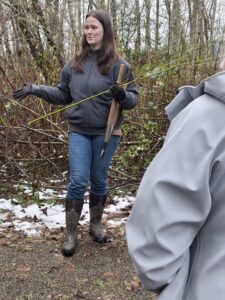
A combination of classroom teachers, former teachers and nonformal educators attended the in-person training on a snowy day in mid-March. The facilitators had to adapt their activities based on the ground temperature, so while participants toured the rain garden and got demonstrations of water quality monitoring and ‘live staking’ willow branches, they didn’t engage in those activities themselves.
Not all participants were local. One traveled all the way from Issaquah, despite the wintry conditions. Barton hopes they’ll apply what they’ve learned and connect with groups in their regions. “We want people to understand that there are other hidden gems like Theler Wetlands,” she says. “If they live further away, they can reach out to their local fisheries enhancement group or land trust and ask if they also do these activities with students.”
Lisa Boynton is a student in Washington State University’s Certified Naturalist Program. She plans to use what she learned at the workshop in her work as a volunteer at Theler Wetlands. “This program will definitely help me to be more educated before I teach others,” she says. “Sharing ways to care for and preserve nature in Washington State is so important.”
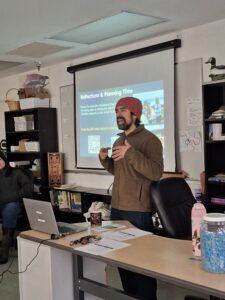
The morning ended with planning time for participants to consider ways to apply what they’d learned with students, with guidance from Cuevas, Sosa and Barton. Cathy Buck, a former Riverview School District middle school teacher, plans to contact Sosa and Barton to dive further into wetlands education. Buck currently serves on the executive committee for The Mountaineers Naturalist Outdoor Program.
“I’ve always been a big advocate for outdoor education,” she says, “and for students having a hands-on, personal connection with nature.”
Mason and Kitsap County teachers can contact The Salmon Center to arrange a field experience at Theler Wetlands. As Barton suggested, teachers in other regions can contact their local salmon enhancement groups and/or land trusts to learn about educational opportunities.