In 1999, a national study found that 59% of Americans didn’t know what the term ‘watershed’ meant. Even today, the United States Geological Survey (USGS) notes that approximately 80% of Americans in urban areas are unaware of the networks of urban creeks and waterways that run through their communities.
Yet watersheds are vital to local ecosystems and community health. They function as natural filters for the water we drink and use for agriculture, prevent erosion and flooding and support biodiversity by providing habitats for wildlife. “It’s very important for people to understand where they live and why it’s important to protect the watershed,” says Lourdes Flores, owner of Simbiosis Consulting. “It matters what we put in the water.”
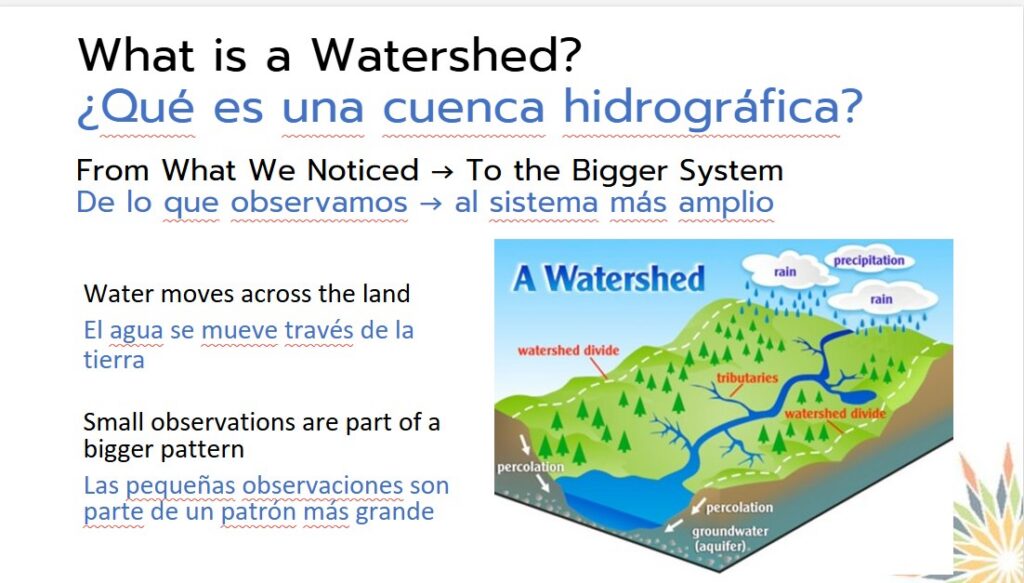
That message was at the heart of a recent Watersheds and Healthy Ecosystems workshop conducted in both English and Spanish. The City of Olympia funded the workshop through an Inspire Olympia grant as part of a larger effort to connect the Hispanic and Latino Heritage community in Olympia and surrounding areas to nearby nature and share Spanish-language resources with dual-language educators.
“This is a good opportunity to expand knowledge for teachers and connect with students. An important step is to understand why we have to be careful about what goes into the water and how our actions impact our watersheds.”
— Lourdes Flores, Simbiosis Consulting
Although the workshop was virtual, co-facilitators Flores and PEI’s Lower Columbia FieldSTEM Coordinator Emily Newman kicked things off by having educators go outdoors to observe their environment and think about where the water flows in their local landscape. “The outdoor observation activity resonated strongly,” says Newman. “That simple activity helped ground the conservation in place-based learning and reminded teachers how powerful observation can be for students.”
The group observed a ‘crumpled paper watershed’ activity that illustrates where pollution travels once different altitudes are introduced. After a brief overview of watershed basics, they explored PEI’s English Language Arts ‘performance tasks’ in both English and Spanish and how watershed topics can support literacy and writing in addition to science learning. Performance tasks are mini-units that integrate Language Arts or math standards with science or social studies.
Siri Nelson, Education Program Manager at LOTT Clean Water Alliance, shared resources and information about careers in watershed science and how regional projects connect to student learning and available resources. “Siri’s presentation provided practical connections to the real-world work happening in their local watershed,” Newman notes. “Participants appreciated learning about how wastewater treatment, stormwater management and water quality protection are all part of maintaining healthy watersheds.”
The next step will be for teachers to share that knowledge with students. “We shared resources they can use right away, including watershed activities and interdisciplinary ELA performance tasks in Spanish and English,” says Newman. “We’re here to support them if they reach out to us.”
Flores hopes that the workshop series, along with two community engagement events supported by the Inspire Olympia grant, strengthens awareness among the Latin Heritage community and other residents. “This is a good opportunity to expand knowledge for teachers and connect with students,” she says. “An important step is to understand why we have to be careful about what goes into the water and how our actions impact our watersheds.”