It’s a number that haunts Gavin Doree: Of the 342 million people in the United States, just 2% are directly involved in farming.
“This is a terrifying statistic, because the industry is so dependent on such a small group of people,” says Doree, Director of Business Development at Rainier Seeds. “If we can get more kids excited about getting involved in agricultural operations, we can diffuse that risk. There are so many opportunities within agriculture for kids, but I don’t think we do a good enough job of creating pathways for children to explore those.”

Doree can take heart. Last week, he joined PEI and a team of presenters for an Engaging Communities in Agriculture Education workshop at Vetter Farms for eastern Washington teachers. The group explored local agricultural practices, engaged in hands-on agricultural lessons and activities, and connected with community-based organizations that can support the implementation of agriculture education. “I had no idea I could contact so many different agencies for support in the classroom,” one teacher shared.
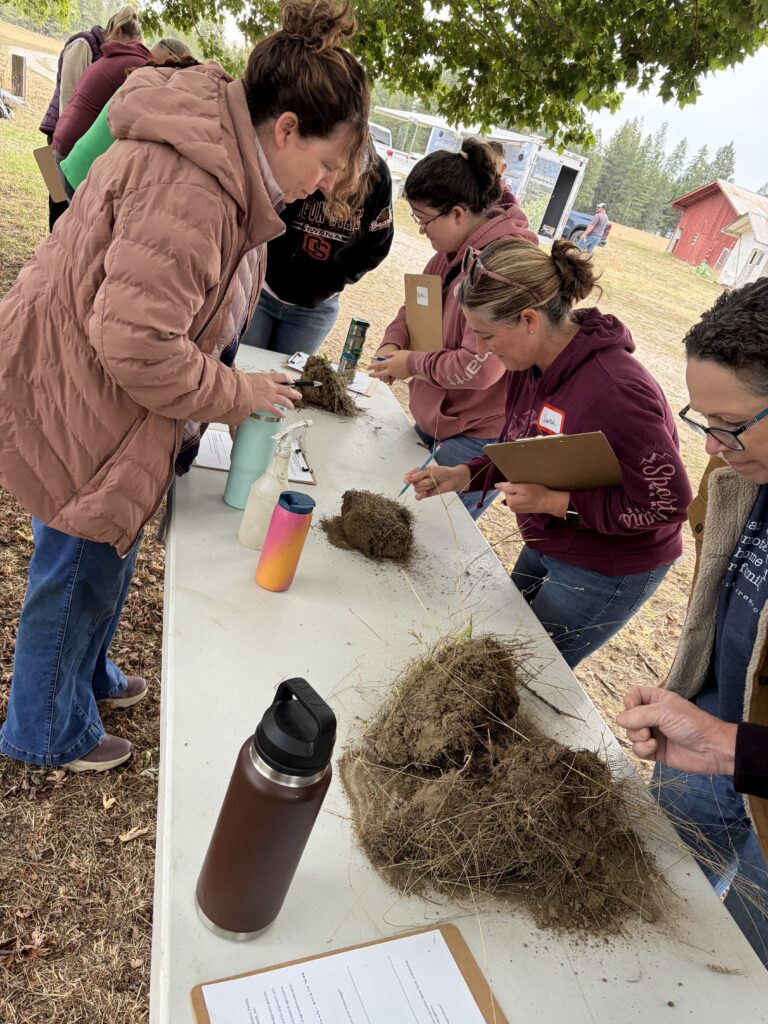
The hands-on learning was a particular hit with teachers, according to PEI’s Eastern Washington FieldSTEM Coordinator Amy Dawley. “Very few of us retain information from sit-and-listen passive learning,” she notes. “It was all ‘hands-in’ as teachers dug their way through soil chunks collected from the Vetter Farm within the first half hour. They made observations, asked questions, and discussed all the possibilities related to their curiosity with their activity team. One of the most valuable benefits resulting from this active practice is the increased confidence to adopt and facilitate the activity with their own students.”
“I had no idea I could contact so many different agencies for support in the classroom.”
— ECAE Workshop Participant
As a case in point, one teacher explained her shift in attitude by the workshop’s end. “This is still intimidating to me, but baby steps mean I can cross the street and talk about what we see instead of showing my students pictures from a book.”
Guest presenters representing Pend Oreille Conservation District, Stevens County Conservation District, WSU Stevens County Extension, Natural Resources Conservation Service (NRCS) and Rainier Seeds led sessions on soil health, erosion and the business side of agriculture. A highlight for the day was a one-hour regional producer panel with seven individuals representing six family operations. After a brief introduction where we heard about their current successes and challenges, workshop teachers were able to discuss topics of interest with them directly. Two of the farmers were ages 18 and 20, respectively.
“A lot of the teachers were very surprised and happy that we had two young people on our producers panel who could speak from a student’s perspective,” says Doree.
He and NRCS Rangeland Management Specialist Saundra Morris led a soil profile exploration that helped teachers understand how foundational soil is to farming. “Soil is like a bank statement,” Doree explains. “It will tell you exactly what is happening and whether the decisions you are making are good or bad. It is brutally honest.” Participants studied soil ‘slices’ from different areas of the farm to understand issues like fungal and microbial activity and nutrient/ organic matter recycling.
Later, they visited the NRCS Soil Health Trailer to witness a rainfall simulator and wind erosion demonstration. “The hands-on presentations about soil, runoff, and soil drainage were the best I’ve seen,” one participant reported in a post-workshop evaluation.
Many voiced a commitment to embedding agricultural exploration in their instruction, Dawley says, and are planning to implement at least one of the activities they learned with students. “I was skeptical at the beginning, since I am outdoor-averse,” one shared in an evaluation. “As the course unfolded, I found myself excited at the possibilities!”
Doree hopes the group takes away a deeper understanding of the possibilities available for young people through agriculture. “My challenge to the STEM community is to find ways to get more involved in agricultural operations,” he says. “Let’s create more access to these opportunities for students and then empower them to be successful as they pursue those pathways.”